
Paint by Numbers Guides
A Creovia beginner guide
Paint by Numbers Brush Shapes: Round, Flat, Angled, or Filbert?
Learn how round, flat, angled, and filbert brushes differ, what each shape is suited to, and how to choose a practical brush for a numbered canvas.
Paint by Numbers Brush Shapes: Round, Flat, Angled, or Filbert?
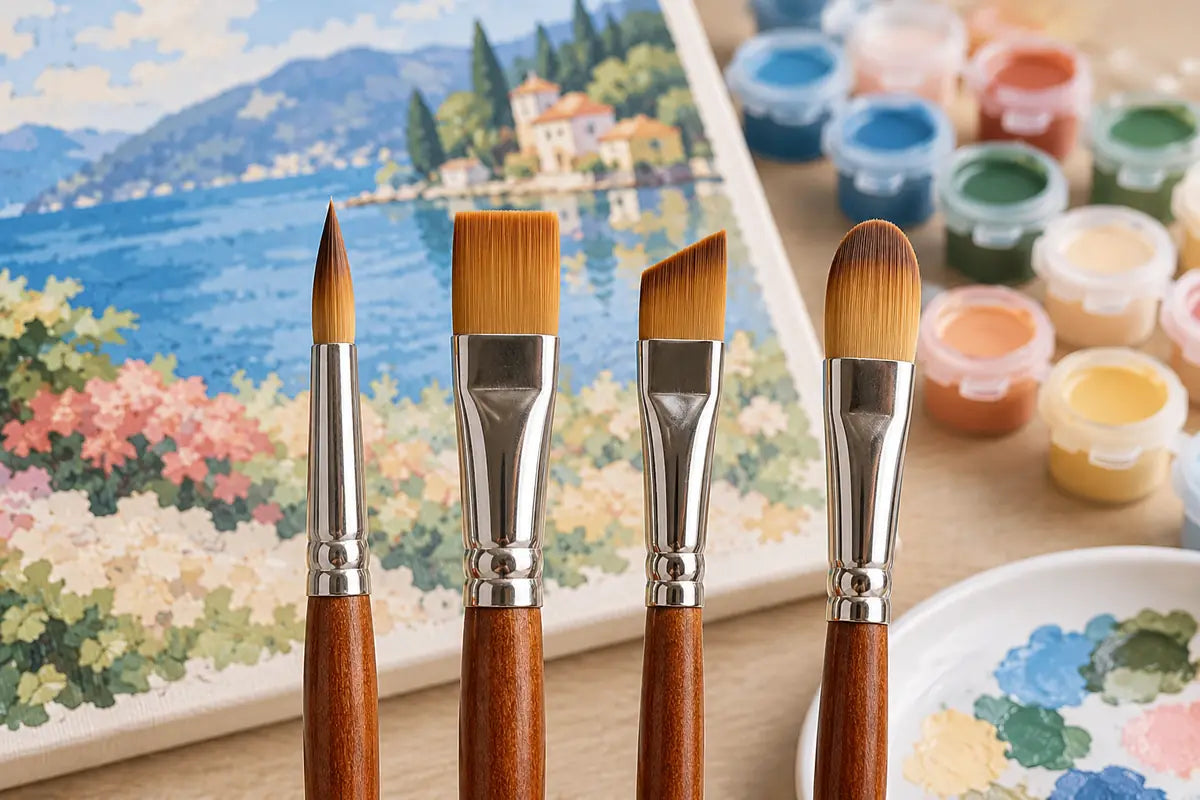
The brush shape changes how paint reaches a numbered area. A round brush comes to a point, a flat brush has a straight edge, an angled brush has a slanted edge, and a filbert has a rounded flat tip. The useful choice depends on the section in front of you: a narrow line, broad block, corner, or curved petal.
You do not need a separate brush for every number. Start with the brushes supplied with your kit, then add another shape only if it solves a recurring problem. This guide explains the shapes without treating any one type as universally best.

What the four common brush shapes do
Round: controlled lines and small areas
A round brush narrows to a point, which makes it useful for short lines, small marks, and compact numbered shapes. A larger round brush can still cover a modest area; the pointed tip simply gives you a clear place to guide the stroke. It can be easier to turn around a small curve than a wide flat brush. If the area is broader than the brush, work in a few connected strokes instead of pressing down to force extra coverage.
Flat: broader fills and straight boundaries
A flat brush holds a squared-off edge. It can cover a wider patch with fewer passes and can help follow straight boundaries, such as the edge of a building, table, or sky shape. For narrow cells, the same width can feel clumsy. Check the width of the paintable space before loading the brush, and use its corner for a short edge only when you can keep the stroke controlled.
Angled: corners and directional strokes
An angled brush places the bristles on a diagonal. That edge can approach a corner or follow a sloping boundary from a more comfortable direction. It is not automatically more precise than a round brush; the result depends on how the brush is turned and how much paint is on it. Try it on a scrap surface first if you are unfamiliar with the shape.
Filbert: rounded transitions and soft-edged marks
A filbert combines a flat body with a rounded end. Its profile can follow curved shapes and create softer-looking marks than a sharp flat edge. On a numbered canvas, use it where a curved outline or a rounded color area benefits from that end shape. It will not blend adjacent numbered colors into a new image; keep each color inside its printed section unless your kit instructions say otherwise.
Match the brush to the painted area
Before choosing, look at the outline rather than the number printed inside it. A small area with a pointed end calls for a narrow brush. A long, straight boundary may be easier to approach with a flat or angled edge. A wide field can take a broader brush if the paintable area is large enough. Rounded flowers, leaves, and animal markings may suit a round or filbert brush, depending on their size.
Brush size matters alongside shape. A shape that works in one size may be too large in another. The Creovia 12-piece artist brush set lists Round, Flat, Angled, and Filbert as separate style variants, with twelve graduated sizes in each selected set. That listing is useful for comparing the options; check the current selection before ordering, because one chosen style is supplied per set.

Paint loading and pressure matter more than the label
A brush may leave a ragged edge when it carries too much paint, even if its shape is appropriate. Pick up a small amount, spread it within the boundary, and reload when the brush begins to drag. Avoid pushing the bristles hard against the canvas; pressure can splay the tip and make the mark wider than expected. If the paint seems stiff or thick, check the paint instructions before adding water or another medium.
When moving between colors, clean the brush promptly and remove excess water before taking up the next paint. The kit's paint is intended to be used with its own directions; this guide is about selecting a brush profile, not changing the paint formula. A separate small-tip brush guide is available for close detail work, and the first paint by numbers session guide covers setup and color matching.
A simple way to test a shape
- Choose one representative area with a straight edge and one with a curve.
- On scrap card or a permitted spare area, try a short stroke with a light paint load.
- Compare control, coverage, and how often you need to reload.
- Use the shape that makes the next few strokes easier, then switch if the canvas presents a different boundary.
This is a practical trial, not a speed test. The exact texture of the canvas and the dimensions of its printed sections vary by design. A brush should help you place paint carefully; it cannot make every marked area the same size or remove the need to check the number and color key.
When a detail set is more useful
If most of your difficulty is fitting paint inside tiny printed cells, a fine-point set may be more relevant than choosing between broad shapes. Creovia's precision detail brushes are listed as a six-piece set for fine lines, outlines, small numbered areas, and touch-ups. They address a different job from a mixed-shape set. Compare the product description with the kind of sections in your canvas rather than buying both by default.
For a design and format comparison, browse the current paint by numbers collection and verify the dimensions, included materials, and frame options on the individual listing.
Frequently asked questions
Which brush shape is easiest for paint by numbers?
There is no single easiest shape for every canvas. A round brush can suit small marks, a flat brush broad fills, an angled brush corners, and a filbert curved areas. Choose by the marked section.
Is a round or flat brush better for small numbered areas?
A small round brush often gives a pointed contact area. A narrow flat brush can work for a small straight section. Test the size and edge before painting the whole area.
What is an angled paint brush used for?
Its slanted edge can approach corners and follow diagonal boundaries. Turn the brush to find a comfortable stroke direction and use light pressure.
What does a filbert brush do in paint by numbers?
A filbert has a flat body with a rounded end. It can follow curved sections and make a softer edge than a squared-off flat brush.
Do paint by numbers kits include different brush shapes?
Kit contents vary by listing. Check the specific product's included-items description; an accessory set is separate unless the listing states it is included.
Find your next project
Explore paint by numbers kits.

Custom Paint by Numbers Kit From Your Photo
$34.99

Coastal Village Flower Stairway Paint by Numbers Kit
$29.99

Milan Tram Corner Evening Paint by Numbers Kit
$29.99
Boston Lighthouse Island Path Paint by Numbers Kit
$29.99

Copenhagen Canal Bicycle Bridge Paint by Numbers Kit
$29.99
Lisbon Rooftop River View Paint by Numbers Kit
$29.99
Marrakesh Blue Roof Courtyard Paint by Numbers Kit
$29.99


