Diamond Painting Guides

A Creovia beginner guide
How to Follow Crystal Ball Highlights in Diamond Painting
Use the chart to keep a crystal ball’s reflected light and circular outline clear, even when the preview makes nearby colors look similar.
A crystal ball in diamond painting is built from separate color placements, not from a layer of transparent glass. Keep its rim, bright patches, and darker areas tied to the printed symbols. Do not replace part of the chart with white drills simply because the reference picture makes the ball look luminous.
Find the edge before the glow
Start by locating the ball’s outer boundary in the design and then finding that area on the canvas. Compare the symbols immediately inside and outside the circle. A paw, sleeve, or stand may overlap it, so the apparent circle may not continue as one uninterrupted line.
Work on a small visible section. Place a short run, check it against the key, and continue around the edge only where the printed guide supports it. The goal is to keep an overlap readable, not to force the entire object into a perfect outline of one color.

Treat a highlight as a group of symbols
The brightest patch can include several shades. Check each symbol even when the reference looks like a single pale reflection. Keep the active packets separate and open only a manageable amount of drills so a pale highlight color does not mix with a nearby background shade.
I would check one small highlight against its surroundings before filling the whole area. From very close up, a few placements can look disconnected; step back to see how the contrast reads, then return to the chart for the next color. Do not let viewing distance replace symbol matching.
Use the product artwork to understand the subject
The Mystic Raccoon Oracle Crystal Ball and Raccoon Wizard Crystal Ball Moon are two current examples. Their gallery images show how a ball can sit among paws, clothing, and other decorative elements.
The reference helps explain which object you are working on. It is not a request to redraw the circle or to add a reflection not represented in the printed grid. The exact highlight pattern belongs to the chosen design.

Keep the neighboring subject separate
Where a paw crosses the ball, compare the two areas with the symbol key before filling a long run. Similar warm or pale shades may appear on both sides of the boundary. The symbol tells you which packet to use; the image helps you understand why the border changes direction.
If a few pieces are misplaced, pause while the area is still easy to inspect. Use the kit’s supported correction method rather than scraping a filled section. For a broader surface problem, use the relevant troubleshooting guide instead of repeatedly pressing the same patch.
Avoid changing the effect with extra materials
The light effect comes from the design’s color arrangement and the faceted drills. Adding varnish, loose glitter, a paint highlight, or a different style of bead is not part of following the chart. Such changes can alter the result and may not suit the canvas or adhesive.
Use the supplied materials as directed. A feature that looks glassy in an illustration is still a coded section of this craft, not a reason to apply a real glass-finishing technique.
Check the picture before calling it finished
Look for unfilled symbols around the rim and where the stand meets the ball. Then view the picture from a normal display distance. A dark edge or a small bright patch may make more sense at that distance than under a magnifier.
For chart basics, read how to read diamond painting symbols. If you are still choosing the format, use the size guide and review the exact product options.
The cover is an editorial illustration. Refer to the product galleries for the listed designs and kit details.
Frequently asked questions
Should I use white drills for every crystal ball highlight?
No. Follow the printed symbol and its assigned color. A pale-looking reflection can contain several shades.
Should the crystal ball have one continuous outline color?
Only if the chart shows that. Paws, clothing, the stand, and changing light can interrupt the apparent circle.
Can I add paint or glitter to make the ball look brighter?
Do not add unapproved materials to the adhesive canvas. Follow the kit directions and the supplied color chart.
Why does the highlight look different close up?
A small group of separate drill colors may read differently from normal viewing distance. Check placement against the symbols, then step back to assess the overall design.
Find your next project
Explore diamond painting kits.

Colorful Village Street Diamond Painting Kit
$23.99
Tropical Hibiscus Queen Diamond Painting Kit
$23.99

Santa Hug Reindeer Diamond Painting Kit Christmas
$23.99

Little Bookshop Garden Diamond Painting Kit
$23.99

Parisian Patisserie Diamond Painting Kit
$23.99
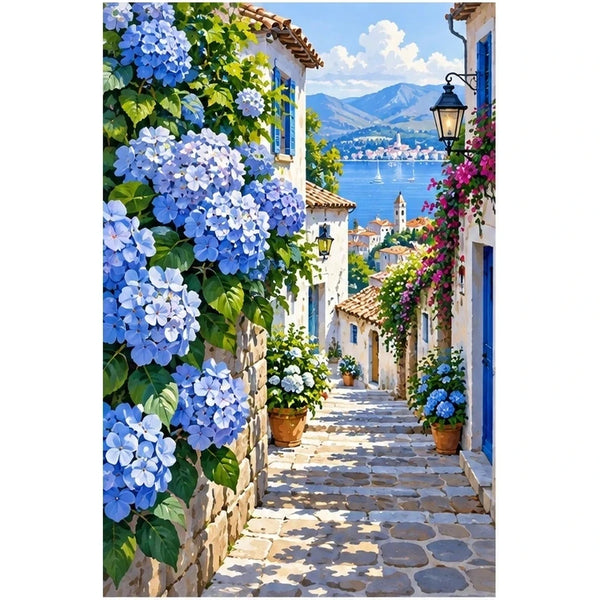
Blue Hydrangea Village Diamond Painting Kit
$23.99

Tropical Macaw Hibiscus Diamond Painting Kit
$23.99